The Power of Round Infographic Design Elements in Modern Visual Communication
In an era where attention spans are measured in seconds and information overload is the norm, the ability to communicate complex ideas quickly and memorably has become a defining skill for professionals across every industry. Visual communication is no longer a nice-to-have supplement; it is the backbone of how brands, creators, and businesses convey value, tell stories, and drive action. Among the most versatile and impactful tools in this landscape are Round Infographic Design Elements —a collection of circular frames, radial patterns, concentric particles, and vector-based infographic assets that offer a structured yet flexible foundation for data visualization, branding, and digital storytelling. This article explores what these elements are, why they matter now more than ever, and how professionals can leverage them to elevate their creative and strategic output.
What Are Round Infographic Design Elements?
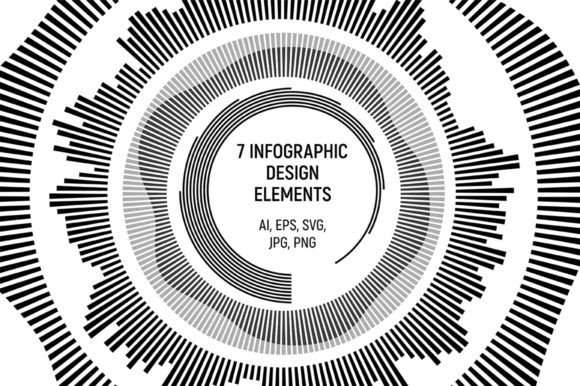
Round Infographic Design Elements refer to a curated set of seven vector-based design assets built around circular and radial geometries. Each element is available in multiple formats—AI, EPS, JPG (5000x5000px at 300dpi), transparent PNG, and SVG—making them highly adaptable for print, web, motion graphics, and presentation use. The collection includes circular frames, round shapes, and radial black concentric particles that can be used individually or combined to create sophisticated infographics, diagrams, process flows, and decorative compositions.
What distinguishes these elements from generic clip art is their deliberate design for data and concept visualization. The circular form is inherently intuitive for human perception: it suggests cycles, continuity, relationships, and hierarchy. When combined with radial particles and concentric structures, these elements enable designers and communicators to build visual narratives that guide the viewer’s eye naturally from the center outward—or around a loop—making abstract information feel tangible and accessible.
The inclusion of both vector and high-resolution raster formats ensures that whether you are creating a billboard, a social media graphic, a white paper, or an interactive dashboard, the elements maintain crispness and scalability. This technical versatility is part of why the collection has found traction among graphic designers, marketing teams, content creators, and business strategists who need reliable, professional-grade assets on demand.
The Broader Context: Why Circular Visuals Are Gaining Momentum
The rise of Round Infographic Design Elements does not happen in a vacuum. It reflects several converging trends in the creative, business, and technology sectors that are reshaping how we process and present information.
1. The Shift Toward Data Storytelling
Organizations today generate more data than ever, but raw numbers rarely persuade or inspire. The demand for data storytelling—the practice of weaving data into a narrative with visual support—has grown exponentially. Circular infographics are particularly effective here because they can represent proportions, progressions, and interconnected systems in ways that linear charts cannot. A radial diagram can show how multiple factors contribute to a single outcome, or how a process loops back on itself, which is common in sustainability reports, customer journey maps, and product lifecycles.
2. The Minimalist and Clean Aesthetic
Modern design trends favor clarity, whitespace, and purposeful geometry. Round elements, especially those with concentric particles and clean circular frames, fit seamlessly into minimalist layouts. They add visual interest without clutter. This aligns with the broader shift toward user-centric design principles where every element must earn its place by serving a communicative function. Professionals are moving away from ornate, distracting graphics and toward assets that feel intentional and refined.
3. The Rise of Remote and Asynchronous Communication
With distributed teams and hybrid work becoming standard, the need for visuals that communicate clearly without verbal explanation has intensified. An infographic built with round design elements can be understood across time zones, languages, and cultural contexts. This reduces meeting time, lowers misinterpretation risk, and speeds up decision-making. Entrepreneurs and freelancers especially rely on such assets to create pitch decks, client reports, and educational content that stand alone.
Why Professionals Are Paying Attention
The sustained interest in Round Infographic Design Elements can be attributed to three key factors that directly address the changing needs of modern professionals.
1. Efficiency Without Sacrificing Quality
Time is the most constrained resource for creators and marketers. Building custom infographic components from scratch is labor-intensive and often requires specialized skills in vector software. A pre-made collection of professionally designed round elements eliminates the need to reinvent the wheel—literally and figuratively. With files ready in AI, EPS, PNG, and SVG formats, users can drop them directly into Adobe Illustrator, Photoshop, Figma, Canva, or PowerPoint and adapt them within minutes. This efficiency is especially valuable for freelancers juggling multiple clients or marketing teams facing tight campaign deadlines.
2. Consistency Across Channels
Brand coherence is a persistent challenge, particularly for small businesses and solopreneurs who manage their own visual output. Using a unified set of round infographic elements ensures that every piece of content—from a LinkedIn carousel to a printed brochure—shares a cohesive visual language. The black concentric particles and circular frames in this collection provide a neutral yet distinctive aesthetic that can be colorized or styled to match any brand palette without losing structural integrity.
3. Accessibility for Non-Designers
Not everyone who needs to create compelling visuals has a background in design. Entrepreneurs, consultants, educators, and marketers often find themselves in the position of needing to communicate visually without formal training. The intuitive nature of round infographic elements lowers the barrier to entry. Because the shapes are already balanced and proportioned, even a novice user can arrange them into a coherent infographic by following basic principles of alignment and hierarchy. This democratization of design is a major reason why vector asset collections have become indispensable in the modern toolkit.
Changing Workflows and Expectations
The way professionals approach visual content creation has shifted fundamentally in the last few years. Where once the expectation was to hire a dedicated designer or agency for every project, today’s workflows emphasize agility, iteration, and in-house capability. Round Infographic Design Elements support this evolution in several practical ways.
Modular Design Thinking
Modern content creation often follows a modular approach: create core assets once, then recombine and repurpose them across formats. The seven elements in this collection function as building blocks. A single circular frame might serve as a border for a statistic in one post, become the outer ring of a process diagram in another, and be scaled down as an accent icon in a third. This modularity reduces redundancy and extends the value of each asset.
High-Resolution for Multiple Outputs
The 5000x5000px resolution at 300dpi means these elements are suitable for large-format printing as well as digital screens. This dual-use capability is increasingly important as brands produce both physical and digital content simultaneously. A trade show poster and an Instagram story can draw from the same source files, ensuring visual consistency across touchpoints. The transparent PNG and SVG variants further streamline this workflow by eliminating background cleanup.
Collaboration and Handoff
When teams collaborate across different software ecosystems—some using Adobe products, others using web-based tools—format compatibility becomes critical. The inclusion of AI and EPS files serves the professional design pipeline, while SVG and PNG files support rapid prototyping and web use. This reduces friction during handoffs between designers, developers, and content managers.
Practical Examples of Use
To ground the discussion in real-world application, consider how different professionals might integrate Round Infographic Design Elements into their work.
Marketing Manager Building a Campaign Report
A marketing manager needs to present quarterly performance metrics to stakeholders. Using the round frames and concentric particles, they create a set of radial charts showing market share distribution, customer acquisition channels, and campaign attribution. The circular design makes it easy for viewers to compare proportions at a glance. The manager exports the final infographic as a high-resolution PNG for the slide deck and as an SVG for the company intranet page.
Freelance Graphic Designer Creating a Brand Identity
A freelance designer is developing a visual identity for a wellness startup. The brand’s core message revolves around balance, cycles, and holistic health. The designer uses the round infographic elements as the foundation for the logo mark, website illustrations, and social media templates. The concentric particles evoke a sense of energy and flow, while the clean circular frames provide structure. The client appreciates the coherent visual system that can scale across merchandise, app UI, and print materials.
Entrepreneur Building a Pitch Deck
An entrepreneur is preparing for investor meetings and needs to explain a complex business model involving multiple revenue streams and customer feedback loops. They use a combination of round frames and radial particles to illustrate how the different parts of the ecosystem interact. The infographic replaces several slides of bullet points, making the pitch more engaging and easier to follow. The investor responds positively to the clarity of the visual, and the entrepreneur closes the round of funding.
Educator Designing Learning Materials
A university instructor is creating a module on systems thinking for an online course. They use the round elements to diagram feedback loops, cycles, and interconnected variables. The visual consistency helps students grasp abstract concepts more quickly. The instructor also provides the SVG files to students so they can create their own diagrams, fostering active learning.
Connection to Larger Developments in Visual Content
The growing reliance on structured infographic assets like the Round Infographic Design Elements collection mirrors broader shifts in the content and technology landscape.
The Maturation of the Creator Economy
As more individuals build careers around content creation—from YouTubers and newsletter writers to online course creators—the demand for professional-grade yet accessible design tools has skyrocketed. These creators need assets that help them stand out without requiring a full-time design team. Vector collections that come with transparent backgrounds, multiple format options, and high resolution directly serve this ecosystem. They enable creators to maintain a polished visual identity across platforms while focusing their energy on content rather than production logistics.
Visual Literacy as a Competitive Advantage
In a crowded marketplace, the ability to communicate visually is no longer just a creative skill—it is a strategic differentiator. Companies that invest in clear, compelling visuals see higher engagement rates, better retention of information among their audiences, and stronger brand recall. Using round infographic elements is a practical step toward building that visual literacy within an organization. It trains teams to think in terms of hierarchy, relationships, and narrative flow rather than simply decorating slides.
Sustainability and Efficiency in Design
There is also a growing awareness of the need to design efficiently—both to reduce waste and to maximize the return on creative effort. Reusable vector assets align with a sustainable design philosophy: create once, use many times. By investing in a collection like this, professionals reduce repetitive work, lower their software and labor costs, and contribute to a more efficient creative industry overall.
Final Observations
Round Infographic Design Elements are far more than a set of shapes. They represent a practical response to the evolving demands of modern visual communication: the need for speed, consistency, scalability, and clarity. In a world where every pixel must earn its place, circular frames and radial particles offer a timeless geometry that humans naturally understand. Whether you are a seasoned designer looking for reliable building blocks, a marketer tasked with making data memorable, or an entrepreneur telling your story to the world, these elements provide a foundation upon which compelling visual narratives can be constructed.
The collection includes seven AI format vector files, seven EPS format vector files, seven JPG files at 5000x5000px and 300dpi, seven transparent background PNG files at 5000x5000px and 300dpi, and seven SVG files. This breadth of formats ensures that no matter your workflow—print, web, presentation, or video—you have the right file type ready to go. Thanks for visiting our shop; the goal is to equip you with assets that save time, elevate quality, and help your ideas resonate.
As you consider your next project, think about how circular structures might bring clarity to your message. The most effective visuals are those that feel inevitable—as if the information could not have been presented any other way. Round infographic design elements, used thoughtfully, bring you closer to that ideal. They turn the complex into the comprehensible, the abstract into the concrete, and the ordinary into the memorable.